









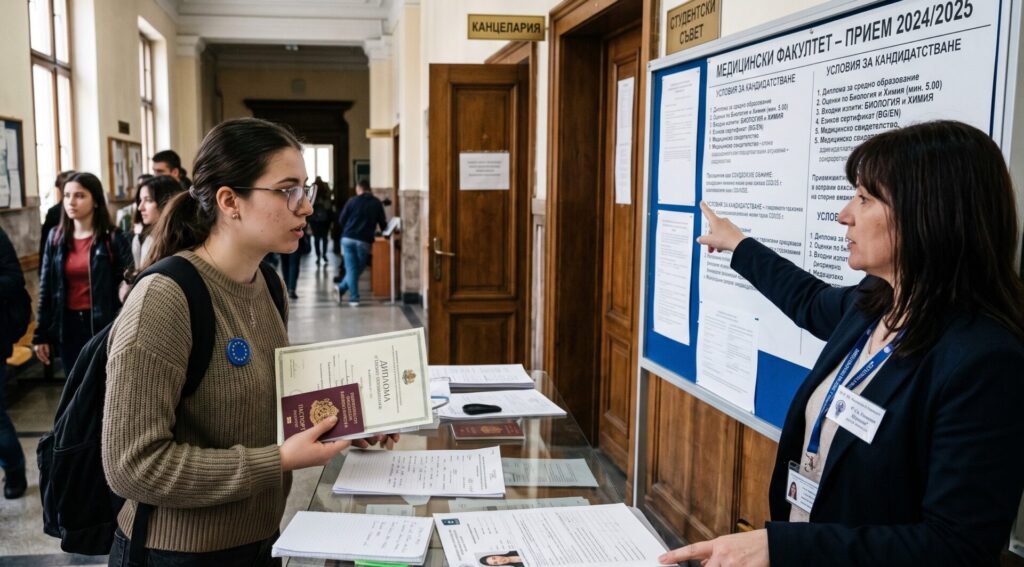
1 of the biggest advantages of applying here is that the medicine entry requirements in Bulgaria are as straightforward as it gets and more accessible compared to many other European countries.
In this guide we’ll break down the admission requirements for Bulgarian medical universities and explain everything international students need to know before applying.
TLDR
As long as you can pass a basic entrance exam, get your paperwork legalised, and have a high school background with good grades, especially in Biology and Chemistry, you're halfway to applying for medicine in Bulgaria.
What are the Entry Requirements and Application Fees for Medicine in Bulgaria in 2026?
You must meet the age limit for studying medicine in Bulgaria, which is 17 years old. Additionally, all universities will assess your school grades and your Biology and Chemistry entrance exam results, both of which will be taken into consideration when they’re reviewing your application.
| University | Entry Requirements | Entrance Exam & Fees |
| Sofia Medical University | Biology and Chemistry grades No less than 62% English proficiency Entrance exam | Biology + Chemistry + English with a fee of €204 |
| Plovdiv Medical University | Biology and Chemistry with an average score of at least 62% of the maximum. Entrance exam English language proficiency | Biology + Chemistry examination. Fees include €30 for data processing and €270 for the entry tests per exam date. An English language test is required if no proof of English language proficiency is provided. |
| Varna Medical University | Secondary education No less than 62% Entrance exam | Biology + Chemistry exam with a fee of €340 |
| Pleven Medical University | Secondary education with Biology & Chemistry gradesMinimum 62% in the official language of the country where high school was completed Entrance exam | Biology + Chemistry exam with €40 registration fee and €200 entry exam fee. |
| Trakia University | Secondary education with Biology & Chemistry subjects No less than 62% Entrance exam | Biology and Chemistry for Medicine (or Biology only for Veterinary Medicine), while students from non-English-speaking countries must also pass an English language exam. The fee is €80 per exam. |
| University of Sofia St Kliment Ohridski | Secondary-school diploma, including Biology and Chemistry grades No less than 62% Entrance exam | Biology + Chemistry with an application fee of €51 |
| Prof Dr Assen Zlatarov University Faculty of Medicine | Completed secondary education Good Biology and Chemistry grades Non-EU and non-EEA applicants must have an average Biology and Chemistry grade of at least 62% of the maximumThe official-language state matriculation requirement of at least 62% English proficiency. | Online entrance exams in Biology and Chemistry, while non-native English speakers without a valid certificate must also pass a B1 English test. €300 fee for the exams and €150 for document processing. |
Want to learn more about these universities?
Interested in applying? Book a free consultation with 1 of our expert advisors & we will take care of working on your documents, helping you with entrance exams, choosing 1 of the many medical schools in Bulgaria based on what is best for you, and smoothing out the road to becoming the doctor that you’d like to be.
Results Day Warning: 2 Myths Some Agencies Say About Applying to Bulgaria
We hate seeing students get taken advantage of during the stress of Results Day. Every year, students who were told "you're fine, just apply" find out too late that they weren't. Below are the 2 myths we hear most often from other agencies and what’s the real legal standing behind each one.
Myth #1: "Your grades don't matter as long as you pass the entrance exam"
What some agencies say: C or D grades in Biology and Chemistry are perfectly fine, as long as you do well on the university's own entrance test.
The reality: Under the Bulgarian Ordinance on the State Requirements for Admission of Students, non-EU/EEA applicants must have an average grade in their secondary education diploma no lower than 62% of the maximum possible score for the subjects relevant to the programme. For example, some universities ask for 62% in Biology and Chemistry for Medicine, while others require 62% in your official language grade + passed Biology and Chemistry.
This is the official legal floor set by the Bulgarian state. If your average falls below it, your file is inadmissible before an admissions officer even looks at your entrance exam result.
This is exactly why entrance-exam performance can't offset your grades, as the exam is scored after the Ministry-level grade check, not instead of it.
How this myth leads to dire mistakes: A UK student calculating their average by eye often doesn't realise how close a C/B combination sits to this line until a university runs it through their official conversion table (i.e. against Burgas Assen Zlatanov University official admissions terms) by which point they may have already paid an agency deposit.
We always recommend getting your specific average checked against a university's published conversion table before committing to an application, not after. If you are talking to a reputable agency, they will always make sure that your grades are sufficient before even considering applying to Bulgaria.
If you’re still a bit confused, you can check out our own simple breakdown of Article 15, Paragraph 2 of the Ordinance.
Myth #2: "You've got until the September deadline, no rush"
What some agencies say: A-level results are mid-August, the university deadline isn't until mid-September, so there's a month of breathing room.
The reality: A university deadline is meaningless if your paperwork isn't legally recognised in Bulgaria yet. Since 1 October 2025, the recognition of foreign secondary education for university admission purposes is handled by NACID (the National Centre for Information and Documentation). NACID's own current procedure pages confirm that recognition is now carried out by NACID's Executive Director following an expert commission review. No university can enrol you without this certificate.
By law, NACID has up to 1 month (30 days) from the date all documents are submitted to issue a decision and that clock only starts once your file is complete. If anything is missing, incorrectly translated, or not properly legalised, the deadline resets once you fix it.
Here's why you need to apply as early as possible to Bulgaria:
- Results Day is mid-August
- Apostilling your diploma in your home country commonly takes a week or more
- Certified Bulgarian translation and notarisation takes a few more days
- The NACID recognition certificate can take up to 30 days by law, longer if anything needs correcting
- All while most university deadlines are mid-September
Even in the best-case scenario, a student who only starts the process on Results Day is racing a 30-day statutory clock against a roughly 4-week window with zero margin for a missing document, a translation error, or a processing delay during the peak August-September rush.
Universities cannot legally enrol a student without the completed NACID certificate, no matter how badly they want to hold your place.
Agencies who tell students to "just apply, there's time" are securing a deposit today, knowing full well many of these students will be forced to defer to the next intake once the paperwork doesn't clear in time.
Here is the official procedure for applying to NACID and here’s a step-by-step timeline of applying to Bulgaria with official 2026 deadlines.
What are the Required Documents for Studying Medicine in Bulgaria in 2026?
The document checklist is almost identical everywhere. You’ll usually need:
- Legalised high school diploma
- Certified Bulgarian translation of documents
- Passport copy
- Passport photos
- Application form
- Proof that your diploma allows university study in your home country
- NACID recognition certificate for your secondary education
For non-EU students, universities also typically require:
- Type D Bulgarian student visa
- Ministry approval before enrollment
While Bulgaria offers an accessible and straightforward pathway to an EU-recognised medical degree, understanding the grade thresholds and specific entrance exam formats can feel like a guessing game. Missing the strict 62% minimum grade requirement in Biology and Chemistry (or official language grade + passed Biology and Chemistry) or mismanaging your online exam registrations can cause your application to be rejected. Don't leave your entry to chance. Join our FREE upcoming webinar. Learn exactly how your local high school grades convert to the Bulgarian GPA scale, master the high-yield topics for the Biology and Chemistry entry tests, and explore your legal safety nets for secure enrollment in 2026!
What are the English Language Requirements for Medicine in Bulgaria in 2026?
Most universities ask for a B2/B1 level of English language proficiency for Bulgarian medicine programmes in English, which can be demonstrated through:
- IELTS
- TOEFL
- Cambridge English certificates
- PTE Academic
- IB Diploma
- English-language school diplomas
FAQs
What are the Top Medical Universities in Bulgaria with Medicine in English?
Bulgaria has 7 medical schools with medicine in English:
Sofia Medical University
Trakia University
Pleven Medical University
Varna Medical University
Plovdiv Medical University
University of Sofia St Kliment Ohridski
Prof Dr Assen Zlatarov University Faculty of Medicine
Do I Need UCAT To Study Medicine in Bulgaria?
No. They really don’t care about the UCAT, and instead, you just need to pass the university's own entry exams in Biology and Chemistry.
What Grades Do You Need To Study Medicine in Bulgaria?
Entry requirements vary by university and applicant category. Some universities, such as the Medical University of Plovdiv, require applicants to have studied Biology and Chemistry and to have an average score of at least 62% of the maximum in those subjects. Other universities use different criteria, such as the official-language grade from the secondary-school diploma, alongside Biology and Chemistry entrance exams. Hop on a call with our academic advisors, and we’ll help you figure out if you qualify for your chosen university.
How Do You Convert UK Grades to Bulgarian GPA for Medical School?
Some Bulgarian medical universities accept BTEC qualifications, but applicants usually still need strong Biology and Chemistry backgrounds and may be required to sit entrance exams or provide additional academic qualifications.
For the Bulgarian medical university grading system conversion table, check out our blog How to Successfully Apply for Medicine or Dentistry in Bulgaria