
































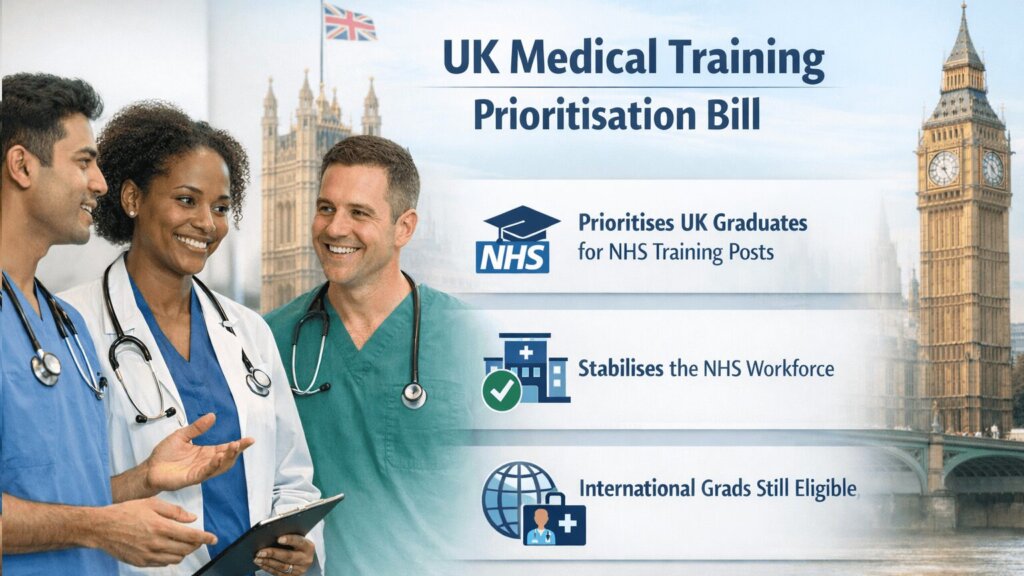
The UK Government introduced the Medical Training (Prioritisation) Bill, which became the Medical Training (Prioritisation) Act 2026 on 5 March 2026. In short, prioritises UK medical graduates and priority groups for foundation and specialty training places.
If you’re a UK student studying medicine abroad, you can definitely still be eligible to apply. Under the Act as passed, British nationals with international medical degrees are generally not prioritised for Foundation Programme places unless they fall into 1 of the specific priority groups.
The key takeaways of this blog include:
- As of the 5th of March, 2026, the Medical Training (Prioritisation) Act 2026 has now passed into law and applies for the 2026 recruitment cycle.
- The world faces a shortfall of 11 million health workers by 2030, and this Act ensures the most suitable candidates are prioritised to fill crucial roles within the NHS.
- The Act prioritises domestic talent, however, the Act as passed has not fully recognised the distinction between British nationals trained abroad and overseas applicants with no UK connection, which is a gap the government should review.
- The Act aims to stabilise the NHS workforce by creating clear pathways for UK graduates and addressing long-standing shortages.
- UK students who have graduated abroad from a reputable medical school still have the flexibility to pursue licensure across Europe, and in the UK.
How Will the Medical Training Prioritisation Act Impact UK Students Who Study in Europe?
UK students students studying abroad can be impacted positively, but this depends on where they study and which stage of training they apply for.
The Medical Training Prioritisation Act gives clear priority to UK medical school graduates for foundation training. It also prioritises graduates from Ireland, Iceland, Liechtenstein, Norway and Switzerland before other overseas applicants. This means a UK student studying in some European countries can definitely benefit from the Act by being placed in the current priority group.
The important point is that studying abroad does not close the door to the NHS. With a suitable medical qualification, GMC registration, and the right career plan, UK students who study in Europe can still return home, gain clinical experience, and build a long-term medical career in the UK. For many students, studying abroad remains a practical way to start their medical education sooner while keeping the UK route open.
The current order of priority groups for foundation training in the NHS is as follows:
- UK-trained graduates (domestic medical graduates from UK medical schools).
- Graduates with a Primary Medical Qualification (PMQ) from Ireland
- Graduates with a PMQ from EFTA countries (Iceland, Liechtenstein, Norway, Switzerland).
For specialty training in 2026, the priority groups are broader and include UK/Irish/EFTA PMQs, doctors who have completed or are currently on relevant UK training programmes, and certain immigration-status groups, including British citizens.
Since the Act has passed, making an informed decision has become a must. If you would like to learn more about your options to study abroad, sign up for a free consultation with 1 of our academic advisors using the form below. Just pick a time and date that suits you and we will answer all your questions.
Can You Skip the Foundation Training Bottleneck?
For most UK graduates, FY1 is the route to full GMC registration, while completion of FY2 demonstrates readiness for specialty or GP training.
However, there are some cases, although rare, where overseas graduates may not need to complete the full UK Foundation Programme if they already hold full GMC registration and can demonstrate equivalent foundation competencies.
However, this is not a simple shortcut. Applicants must still meet the person specification for the training programme they apply to, and many will need UK clinical experience before progressing.
What Does This Mean for Non-UK International Medical Graduates?
In short, Non-UK IMGs can still apply for UK training, but they face more competition and fewer available spots due to the prioritisation of UK-trained doctors. However, the UK is in dire need of doctors due to consistent shortages, so that doesn’t mean that IMGs have no chance of getting in.
What this means in practice
In short, the Act means that:
- UK-trained graduates would be prioritised first for training posts
- IMGs would continue to be fully eligible to apply for NHS training
- Any remaining training positions would be offered to eligible IMGs
- Given the UK’s ongoing and well-documented doctor shortages, training posts are still expected to be available for international graduates
Why IMGs remain an essential part of the NHS
The NHS has relied on international doctors for decades, and this is unlikely to change. Workforce shortages across hospitals and GP practices mean that international graduates continue to play a crucial role in patient care.
Even with prioritisation of domestic graduates, the demand for doctors significantly exceeds supply, creating continued opportunities for IMGs to enter UK training pathways.
A familiar system internationally
Similar prioritisation models already exist in many countries and are considered standard workforce planning, not a restriction on international doctors. The UK proposal reflects this global approach rather than signalling a reduction in opportunities.
How Does the Shortfall of 11 Million Health Workers by 2030 Affect the Medical Training System?
The 11 million health worker shortfall by 2030 is a major driver behind the Medical Training Prioritisation Act. With an ever-increasing need for doctors, the Act addresses this shortage by ensuring that the most suitable candidates are prioritised for NHS training to provide a reliable, skilled workforce.
By focusing on UK-trained doctors, the Act aims to stabilise the system, improve current conditions and reduce reliance on unpredictable international recruitment. It aims to guarantee long-term stability for the NHS without putting UK nationals who studied abroad in EFTA countries at a disadvantage.
Why Is Studying Abroad Still a Strategic Path for Future UK Doctors?
For UK students who are determined to become doctors, studying medicine abroad remains a smart and viable route, especially when UK medical school places are highly competitive.
The Act simply changes priority for Foundation Programme places. Studying abroad does not block students from becoming doctors in the UK.
UK students who study at accredited, reputable medical universities abroad can still return to the UK, apply for GMC registration, and pursue a career in the NHS. With the right university choice and careful career planning, studying abroad can provide a clear route into medicine while helping students avoid the bottleneck of UK medical school admissions.
Many return through alternative routes such as GMC registration with acceptable overseas experience, F2 stand-alone, non-training NHS roles, and later specialty training.
- Avoid the long waiting times and intense competition found in the UK medical school system
- Kickstart their education without having to wait a year to try again for a spot at a UK medical school.
- Take advantage of more flexible entry requirements
- Study at a more affordable destination
- Get high-quality medical education that enables you to return to the UK and get your GMC registration and a licence to practise
In short, with the right planning, studying abroad remains a valid and strategic pathway for UK students who want to become doctors and return to practise in the UK.
For recommendations on the best places to study medicine abroad if you plan on returning to the UK, you can read our blog, The Top Medical Schools Abroad for UK Students According to Stats, Price & Quality
How Can You Take Advantage of The Medical Training Prioritisation Act?
It's important to note that the Medical Training Prioritisation Act does not automatically prioritise every UK national who studies abroad.
This makes careful planning more important than ever. Students should choose a reputable medical school, understand whether their PMQ is acceptable to the GMC, and plan the correct route back into UK practice, whether through foundation training, F2 stand-alone, non-training NHS roles, or later specialty training.
Dr Sam El Mais commented for Times Higher Education that it would be sensible for the system to recognise British nationals trained abroad as a UK-connected group. International graduates also gain international exposure that teaches adaptability in diverse clinical environments. This international experience makes returning British students more resilient, adaptable, and attractive candidates for NHS roles, qualities that are especially valuable given the NHS's current doctor shortage.
How Medlink Students' Graduates Can Get a Competitive Edge in Their Careers
Medlink Students helps students get accepted to accredited and internationally recognised medical schools abroad that meet all GMC requirements. Medlink ensures students attend schools with strong reputations that align with UK medical standards, preparing them for NHS training upon returning home.
We provide full support with our Student Success Programme, from application to graduation and into the start of your medical career. Best of all, graduates from these universities have a lot more options and can get licensed for medicine in the UK, all over Europe, and in many countries across the world.
And let’s not forget that many European countries are also short on doctors, so skilled graduates are always in high demand.
What Are the Main Concerns Students Have About the Medical Training Prioritisation Act?
In 2025, 15,723 UK-trained doctors and 25,257 overseas-trained doctors competed for 12,833 round 1 and 2 specialty training posts. For the 2026 recruitment cycle, the Government has reported over 47,000 applicants for rounds 1 and 2, with final numbers still to be confirmed.
These figures clearly show the rising competition for UK medical training places, particularly as overseas-trained applications have increased.
How does the Act ensure UK students aren’t disadvantaged by studying abroad?
Priority for foundation training is mainly given to graduates with UK, Irish, Icelandic, Liechtenstein, Norwegian or Swiss medical qualifications. However, UK students who study abroad can still return to the UK, apply for GMC registration if they meet the relevant requirements, and pursue NHS careers through appropriate routes.
What are the benefits of the Early Bird Advantage for UK students studying abroad?
In 2025, there were more than 3 applicants for every available speciatraining post in the UK specialty training system (12,833 posts vs. 40,980 applicants). Studying medicine abroad allows UK students to bypass the bottleneck of UK medical school admissions and start their medical education sooner.
How Does the NHS Benefit from the Medical Training Prioritisation Act?
The main benefit is the creation of a more stable medical workforce. The NHS can better plan for the future, knowing that UK graduates will more likely fill critical roles within the system. This reduces reliance on temporary or overseas recruitment, which can be unpredictable and unsustainable.
The Act also strengthens workforce retention, since UK doctors are more likely to stay within the NHS. This will enhance both the long-term stability and sustainability of the local workforce. This ultimately benefits both the NHS and patients, ensuring high-quality care from a well-trained, committed community of skilled professionals.
Why We Care
If you choose the wrong medical school, it could hurt your chances of getting into the NHS training system. If you go to a medical school that doesn't meet all of the GMC's requirements, your qualifications might not be recognised in the UK. This means you will have fewer job opportunities and have to study for longer if you wish to get your medical license with the GMC. The UK training system is already very competitive, so you don't want to make things harder by making the wrong choice now.
At Medlink Students, we work with only top-tier universities that are accredited and internationally recognised to ensure that your qualifications can support your route to registration in the UK and other countries.
Get in touch with 1 of our academic advisors for a free consultation to find out which universities abroad will allow you to return to the UK and become a licensed medical professional.
Don't let uncertainty hold you back. Even with the proposed Medical Training Prioritisation Bill, studying medicine abroad is still one of the smartest and most reliable ways for UK students to become GMC-registered doctors. Discover exactly which accredited European medical schools meet all GMC criteria, how to bypass the UK medical school bottleneck, and how we help you seamlessly return to the NHS.
FAQ:
What is the Medical Training Prioritisation Act?
The Medical Training Prioritisation Act prioritises UK medical graduates and priority groups for foundation and specialty training places. It aims to address the NHS's doctor shortage by focusing on domestic talent while still allowing international graduates to apply, though with more competition.
Is the Medical Training Prioritisation Act in effect?
As of the 5th of March 2026, the Act has passed into law.
How does the Act impact UK students studying medicine abroad?
The impact depends on where they study and which training stage they apply for. For foundation training, priority mainly depends on where your PMQ was awarded. For specialty training in 2026, British citizens with international medical degrees are included in the prioritised group, provided they meet the relevant eligibility criteria.
Will UK students who study abroad still be treated as part of the domestic workforce?
Yes, but only if they are from the priority group. However, UK students who study abroad can still form part of the UK’s future medical workforce, but they are not automatically prioritised just after UK medical school graduates for foundation training. With the right qualification, GMC registration route, and career planning, they can still return to the UK and progress into NHS roles.
Can Non-UK International Medical Graduates still apply for NHS training?
Yes, IMGs can still apply for NHS training, but they will face increased competition as the Act prioritises UK-trained doctors. If there are any remaining spots after UK applicants are considered, IMGs may be offered those positions.
Why is studying abroad now more than ever a strategic path for UK students?
Studying abroad allows UK students to avoid the hyper-competitive entry requirements for UK medical schools, meaning they can start their medical education right away if they choose to study abroad.
How does the Medical Training Prioritisation Act help the NHS?
The Act makes it more likely that UK-trained doctors will fill NHS training positions, reducing the NHS's reliance on overseas recruitment, which can be unpredictable. This keeps the workforce stable, makes it easier to keep employees, and helps make sure that patients get good, long-term care.
What will happen if I go to a medical school that doesn't meet all of the GMC's requirements?
Your qualifications won't be accepted in the UK, which will make it harder for you to get NHS training and may mean you have to study for more years to meet UK standards.
Are there enough NHS training spots for everyone?
No, there is a lot of competition for NHS training spots. In 2025, 40,980 applicants competed for 12,833 round 1 and 2 specialty training posts. For the 2026 recruitment cycle, the Government reported over 47,000 applicants for rounds 1 and 2, with final numbers still to be confirmed.
How can I ensure my qualifications are recognised in the UK?
To ensure your qualifications are recognised, choose a reputable medical school and check whether its PMQ is acceptable for GMC registration purposes. Medlink Students can help you understand which universities can support your route back to GMC registration and UK practice.