












The world of medical education is constantly evolving in order to ensure that students get the most out of their academic journey. New policies and updates have been added over the years to enhance the quality of higher education and university recognition.
A key update happened in 2024. This article will explain this change and how to stay qualified for US medical training and practice. Let's dive in.
TL:DR - From 2024, ECFMG will publicly report (but not block) whether an IMG’s medical school is accredited from a WFME-recognised agency. Residency programmes will now have the transparency needed to choose the best candidates according to medical school accreditation and prospective IMGs should choose their medical school based on this criteria.
What is the ECFMG, and what is ECFMG certification?
The Educational Commission for Foreign Medical Graduates (ECFMG) is an organisation that assesses whether an International Medical Graduate (IMG) is qualified to pursue further medical education and residency training in the United States. Basically, the ECFMG serves as a certification body that ensures that medical students coming from outside the US have met the necessary standards to practise medicine safely.
IMGs are an integral part of the US healthcare system and make up about 25% of all
physicians in graduate medical education, so it is absolutely crucial to have a comprehensive way to assess each graduate’s knowledge and skill level. That’s where the United States Medical Licensing Exam (USMLE) comes in, which every IMG and native student needs to pass in order to become eligible for a residency programme.
However, before tackling the USMLE, graduates need to obtain ECFMG certification, which serves as proof that the student has graduated from a respectable, accredited, and internationally recognised medical university. This certificate serves as a testament to an IMG’s capability and readiness to work with real patients and affirms their preparedness to take on the USMLE.
What is the ECFMG 2024 Update
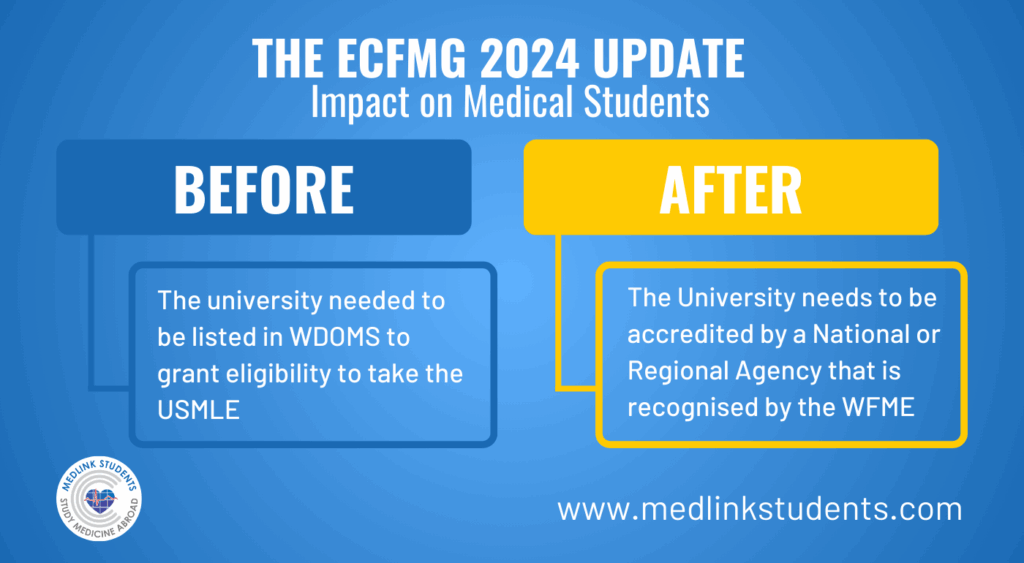
Up until recently, in order to qualify for a US residency programme, all you needed was to:
1. Graduate from a medical university that was listed in the World Directory of Medical Schools (WDOMS) with either a note or a mention of a WFME recognised agency accreditation.
2. That’s essentially a "green light" from ECFMG saying, "We recognise this school, and its students are allowed to sit for the USMLE."
3. Apply to & take the USMLE.
And that’s still the same. Sort of.
Before, any school with a WDOMS Sponsor Note was treated the same. Now, the ECFMG reports whether your school's local accreditor has a WFME/NCFMEA recognition, and residency programmes will now see exactly where your school stands.
Keep in mind that this accreditation status is now used for reporting, not for blocking your eligibility. As long as your school has an ECFMG Sponsor Note in the WDOMS, you are still eligible for the USMLE and certification.
It's also good to mention that the administrative process was overhauled on January 12, 2026. ECFMG no longer manages USMLE exam services. Instead has transitioned to the FSMB portal.
What does this mean for current medical students?
If you’re currently in the middle of your degree or just starting, know these things:
- As long as your school has an active ECFMG Sponsor Note in the World Directory, you can still get certified. The main difference is that residency directors will now see on your report whether your school meets those global standards or not.
- You can’t just go to 1 website anymore. You first need to use the MyIntealth portal to verify your identity and apply for ECFMG Certification. Once ECFMG gives you the green light, you head over to the FSMB portal to actually register and pay for your Step 1 and Step 2 CK exams.
- Regardless of where you’re from or if English is your first language, you must pass the OET Medicine test to satisfy the communication requirement. Make sure your scores are from a test taken within the current two-year window required for your Match cycle.
Implications for residency programmes
The residency programmes in the United States will likely change for the better, resulting in an overall increased quality of practical training. The new standards will play a crucial role in shaping the eligibility of international students, ensuring that only those who have undergone a robust and globally standardised medical education are granted entry into these programmes.
If you haven’t started your academic journey and want to be absolutely certain that the medical school you will be attending is accredited and recognised, you’ve landed in the right place. Medlink Students specialises in finding the best university that aligns with your goals and ambitions, making sure that you receive high-quality medical education.
Our expert advisors possess an in-depth understanding of the latest international standards and requirements in higher education, with which they can guide you toward a successful career path. You can sign up for a free consultation here, and we will make sure that you start your medical education with confidence and peace of mind.
Conclusion
Overall, the path to practising health care in the US stays the same:
- Get an internationally recognised medical degree
- Pass the United States medical licensing examination
- Go through a US national residency program.
However, the ECFMG 2024 update is a great step towards fostering a global standard of excellence in medical education. It is a call for medical schools, local accrediting bodies, students, and the broader medical community to align with these improved standards, ensuring that the future of medical practice is marked by competence, excellence, and global recognition.